
How to Search Civil Dockets
Begin any Neosho County civil docket search at Kansas CaseSearch. Pick Neosho County when the location filter appears. A full case number returns the cleanest result, and newer numbers follow the pattern NOC-year-CV/LM/DM-six digits. The codes split by case type. CV marks regular civil. LM means limited civil, and DM covers domestic matters. The portal carries its own complete code and control list, so follow its live labels. A careful search uses five steps.
- Identify the district, municipal, or federal court level.
- Enter the complete case number, if known.
- Otherwise search a party or business name and narrow by county and filing dates.
- Compare type, filing date, status, judge, and party roles before choosing a result.
- Read the event history and request the exact document needed from the clerk.
The public search is only one channel. CalendarOJA can confirm a listed setting, and both Chanute and Erie offer public terminals plus clerk counters. For phone, mail, copy, or certification questions, the District Court Clerk routes them. A judicial KORA request may apply when directed. Municipal and federal civil matters stay separate.
Neosho Civil Filings Window
The Kansas Civil Filings service is a separate, short-lived layer. It lists newly submitted civil papers before the clerk accepts them. Under the 2025 Kansas Judicial Branch report, a submission stays there for three days unless rejected under Rule 23(c). At that stage, it is not a court record. Treat it as notice. It is not proof that a Neosho County civil case was accepted or even created. The official statewide queue itself shows this holding window.
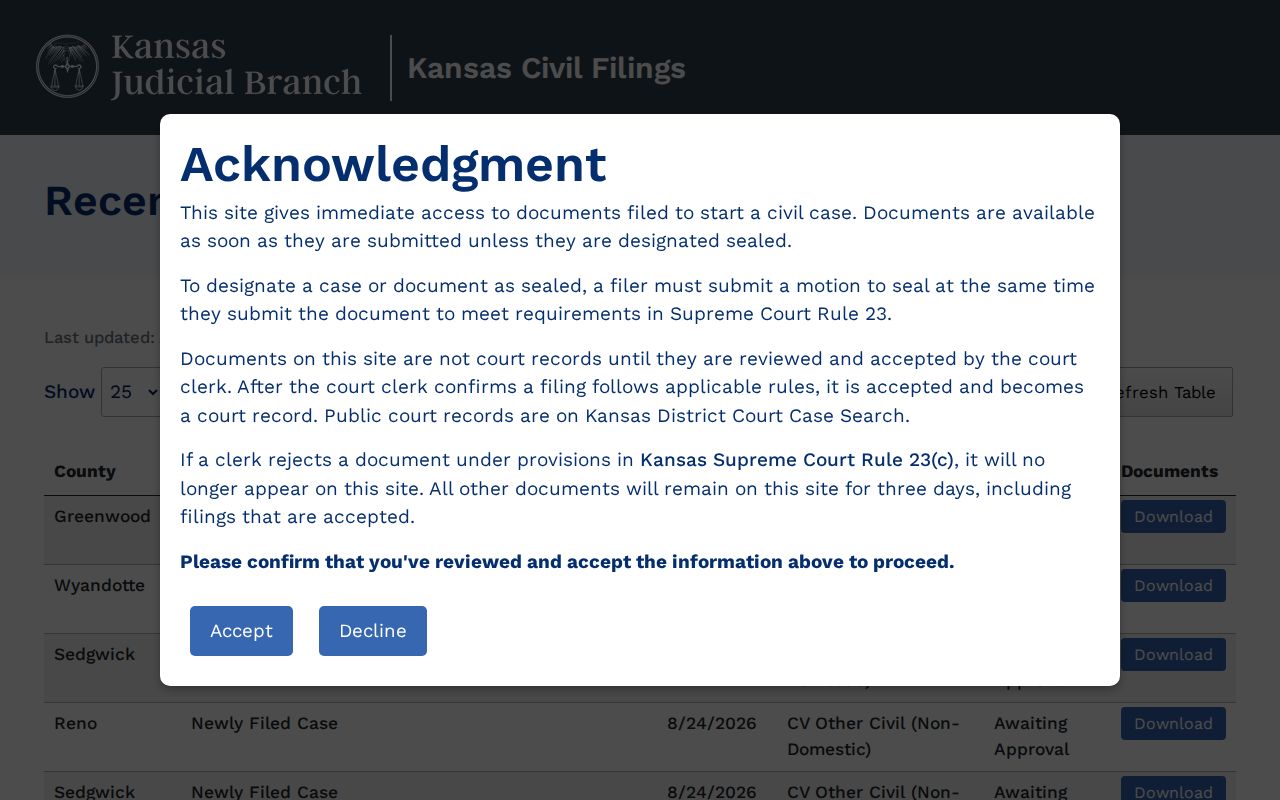
The queue marks the key distinction: submission comes before clerk review. Once accepted, eligible case information and documents move into the district public-access framework.
Do not confuse speed with status. A three-day queue item is not an accepted Neosho County court record until the clerk completes review.
What a Civil Docket Shows
A Neosho County civil docket has a header. It also has a participant area, a chronological event stream, and possible document links. The number and type identify the file. Party roles tell you whether the caption uses plaintiff and defendant or petitioner and respondent. Events may record petitions, answers, service, motions, conferences, mediation, hearings, orders, judgments, dismissals, and appeals. The vocabulary shifts with case type.
| Case number | County prefix, filing year, civil type, and sequence, such as NOC-2024-CV-000001. |
|---|---|
| Parties | Plaintiff/Defendant or Petitioner/Respondent, plus counsel and other roles. |
| Filings | Petition, answer, motion, response, service return, and eligible supporting papers. |
| Settings | Date, time, courtroom, judge, conference or hearing label, and connection. |
| Court action | Order, journal entry, judgment, dismissal, or other recorded disposition. |
A filing is not a ruling. A setting does not prove the event happened. A "final hearing" line is not the final written order. Read forward until the Neosho County docket shows the related order or judgment.
Older Neosho Civil Files
The county's two-division structure changes where a search may end. Per the official 31st Judicial District Neosho page, Chanute handles newer filings from 1955 forward. These include civil, limited-civil, domestic, small-claims, and related cases. Erie keeps civil, limited-civil, small-claims, and domestic files from before September 2001. It also holds probate, liens, marriage-license, care-and-treatment, guardianship and conservatorship, and other listed categories.
Those date ranges overlap. Give the clerk the filing year and case category instead of guessing a location. A case can be heard at either division. The filing site, paper-file site, and hearing site need not match. Call Chanute at 620-431-5700 or Erie at 620-244-3831 before traveling. That matters most for an older file.
Note: Both clerk counters close from noon to 1 p.m. during their published weekday hours.
Types of Civil Cases
The Neosho County civil docket spans more than ordinary lawsuits. Category drives the party labels, likely events, access limits, and possible file location. Common layers include:
- Regular civil actions involving contract, tort, real property, or other claims
- Limited civil actions, including a large share of the county’s reported civil filings
- Domestic relations matters, with document access limits for some case types
- Small claims proceedings under Kansas statutory procedure
- Probate, guardianship, conservatorship, liens, bonds, and other statutory matters
Kansas caps small claims at $10,000 under the official small-claims statute. Older local material may quote a prior ceiling. The current law controls, and the statute itself states the amount.
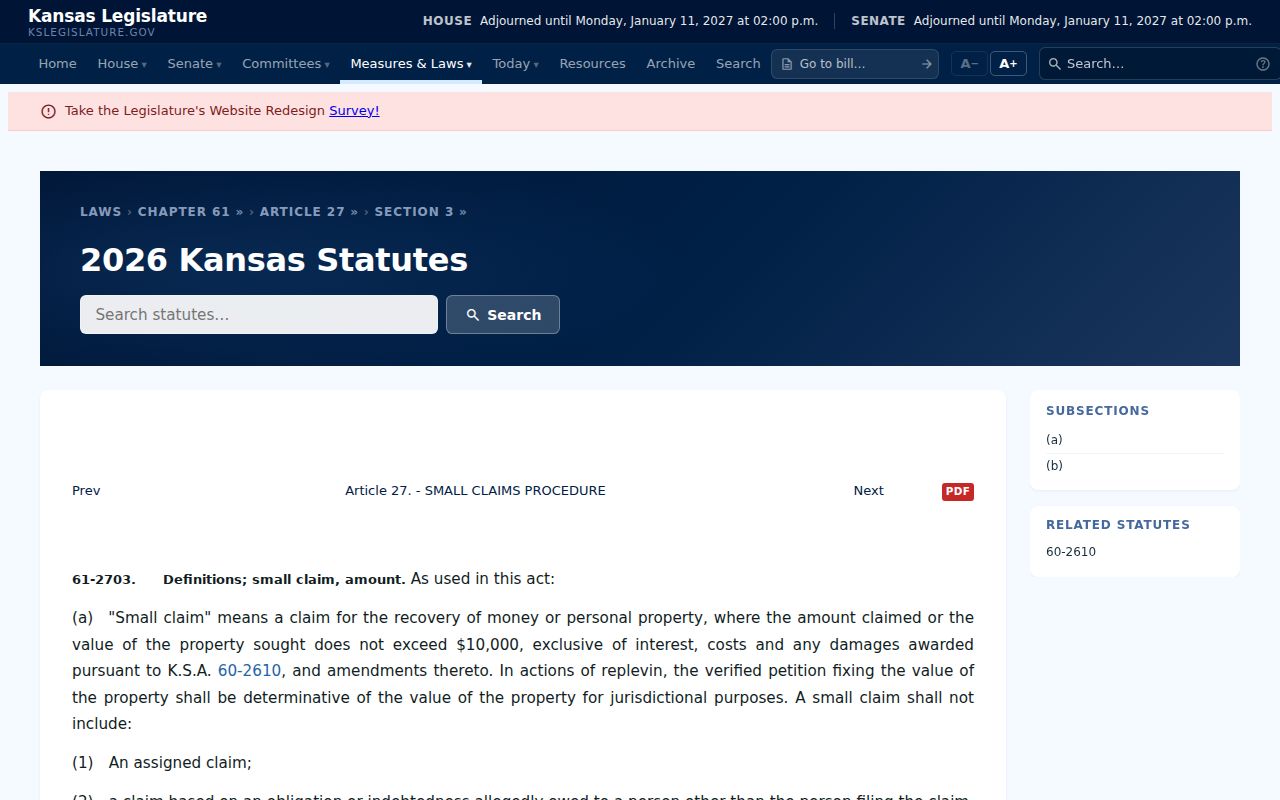
That ties the small-claims category to its current governing source, not an outdated local handout.
Neosho Civil Filing Snapshot
The fiscal-year 2024 civil-filings report counts 506 Neosho County filings. Regular actions made up 52 of them. Limited actions totaled 299, and domestic relations 155. That benchmark covers the year ending June 30, 2024. Treat it as a historical figure rather than a current 2026 tally. The court also posts 2025 civil filings and dispositions PDFs. Those documents are not machine-readable. No newer local count is stated.
The mix helps a searcher pick a case-type filter. But it says nothing about any one dispute or its outcome. The regular-action row includes contract, other, real-property, and tort filings. The domestic row covers several subgroups. For a case's actual status, rely on its own docket and order.
Settings on Civil Dockets
Civil settings come in several forms: status, pretrial, mediation, motion, and final hearings. The 31st Judicial District CalendarOJA shows the date, time, and courtroom. It also lists the judge, case number, party connection, attorney, and setting label for each one. It is a date-range calendar. The full civil event history stays in the case file, not the calendar. Updates run weekly. The district still urges caution. Verify any setting with the court before relying on it.
Watch for resets. A reset can leave an older date sitting in the history. A newer entry controls what actually happens. Service or an answer may change the next step. A scheduling order can set several deadlines that never appear as separate public calendar rows. For a detailed hearing lookup, check the Neosho County court calendar alongside the case itself.
- Pretrial conference
- A case-management setting before trial.
- Mediation conference
- A scheduled effort to resolve issues, not a judgment.
- Final hearing
- A setting label that must be followed by the written order.
- Default
- A procedural status whose scope and effect come from the docket and judgment.
Neosho Civil Party Roles
Read the roles before the names on a Neosho County civil docket. Plaintiff and defendant usually frame an ordinary civil claim. Petitioner and respondent tend to mark domestic or other statutory matters. A state agency or guardian ad litem can signal a different kind of proceeding. So can other connections. CalendarOJA keeps Connection, Party Name, and Attorney Name separate.
| Role pair | Typical context | What to verify |
|---|---|---|
| Plaintiff / Defendant | Regular or limited civil claim | Caption, claims, service, and judgment |
| Petitioner / Respondent | Domestic or statutory proceeding | Case type and public access level |
| Attorney / Connection | Representation or linked role | Whom the entry represents |
One civil case can carry multiple claims and parties. A single dismissal may close just one claim or one party. Do not describe the whole Neosho County civil docket as dismissed without reading the final order.
Public Access to Civil Dockets
Kansas Supreme Court Rule 22 governs public electronic access to case records. A public case shell can appear even when a specific paper stays out of view. Divorce, custody or support, guardianship, parentage, protection-order, and other listed material may be restricted. Documents from before eCourt conversion may sit at a courthouse terminal rather than online. No terminal opens a sealed record.
The practical access chain runs through several doors. CaseSearch comes first, then Kansas Civil Filings for the brief pre-acceptance period. CalendarOJA handles settings. The Chanute or Erie public terminal adds another door. So do the District Court Clerk by phone or counter, a defined written request, and the certified-copy route. Municipal civil-like ordinance matters start with the city clerk. Federal civil cases go through PACER. The courts offer no separate Neosho civil subscription and no public bulk-document route.
Access law: Rule 22 controls court-record publication. Rule 24 protects personal identifiers. K.S.A. 45-218 provides the KORA inspection framework.
Neosho Civil Judgment Copies
A docket entry can name a judgment without supplying a public PDF. Ask the District Court Clerk for the exact judgment, journal entry, or order. Give the case number. Say whether you need an ordinary or certified copy. Say how it should reach you. A judicial KORA form can structure a written request when that process is directed. The Neosho County Clerk's form covers county administrative records. It is not the automatic civil-court route.
The official pages post no current Neosho or 31st Judicial District court copy-fee schedule. So ask first. Get the copy, certification, and transcript amount. Also confirm the accepted payment method before sending any funds. Plan on phone, mail, or counter. A precise request beats a blanket one. Kansas court rules promise no bulk compilation of everything tied to a name.
Note: For an older civil file, give the clerk the filing year and the case category. This lets the Chanute or Erie division route it correctly.