
How to Search the Chanute Court Docket
The City of Chanute offers no public party-name docket interface. Work from the details on your notice: the court name, the citation or case number, and the date. City ordinance or city traffic matter? The Chanute Municipal Court page is the official starting point. A notice naming Neosho County District Court points elsewhere. That case belongs in Kansas CaseSearch or at the District Court Clerk's counter. Keep the two routes separate, because a city payment record is not a state docket.
- Read the issuing Chanute court and agency on the notice before choosing a search channel.
- For Chanute Municipal Court, call or visit the municipal clerk with the citation number and court date.
- For Neosho District Court, search CaseSearch by the full case number, then by a careful name and date range if needed.
- Compare the court, case type, filing date, judge, and next setting before treating a match as the right case.
- Call the proper clerk to confirm an imminent hearing or request a document that is not online.
A newer Chanute district case number may look like NOC-2024-CR-000293. Older notices sometimes drop the county prefix or punctuation. Try both supported forms. One caution: a CaseSearch miss does not mean the Chanute case was dismissed. The municipal record may simply sit outside the statewide district portal.
Chanute Court at the Judicial Center
Chanute's court geography confuses people. Two courts share one address. The City of Chanute Municipal Court and the Neosho County District Court Chanute Division both meet in connection with 102 South Lincoln Street, the Hudson Judicial Center. Sharing a building does not mean sharing jurisdiction or a shared Chanute court docket. The municipal court hears city ordinance violations. The district division holds state cases and a much broader set of files.
Call the District Court Clerk's Chanute line at 620-431-5700. The official district page lists the Chanute counter hours. It opens Monday through Friday from 8 a.m. to noon and 1 p.m. to 4:30 p.m. That noon closure matters. Plan an in-person Chanute docket check around it. The city separately identifies its municipal clerk counter at 101 South Lincoln. Ask for the Chanute office by name rather than trusting the street address alone.
Chanute court routes
Municipal: city ordinance and city traffic records
District: state cases through the Chanute division
District Clerk: 620-431-5700
The Chanute Municipal Court
Under K.S.A. 12-4104, a Kansas municipal court handles ordinance violations within its own city jurisdiction. For Chanute, that usually puts city traffic and local-code matters on the municipal docket. It does not make the city court a branch of Neosho County District Court. State charges, civil suits, domestic cases, probate, and other district matters stay in the state system.
The city's page names Municipal Judge James H. Stewart. Chanute court, it says, is generally held each Wednesday at 2 p.m. at the Hudson Judicial Center. Treat that as the published session pattern. It is not a promise that every case gets called every Wednesday. Your ticket or the clerk controls the actual date. The city publishes no searchable party-name register. The Chanute municipal clerk remains the source for a particular city docket entry.
Chanute Court Phone Routing
Getting the right office on the phone is part of a sound Chanute docket search. City ordinance cases, municipal citations, city payments, and continuance requests all share one route. They go through the municipal court. When a notice names a state case, call the Neosho District Court Chanute Division at 620-431-5700. Court Services, at 620-431-5720, supervises its own assigned functions. It is not the district clerk's record counter.
- Municipal record
- A Chanute city-court event, ticket, judgment, or payment record.
- District record
- A Kansas state-court case filed in the Neosho County District Court system.
- Calendar entry
- A published future setting that still needs confirmation and is not a final disposition.
Be specific when you call. "I need the next setting in a Chanute municipal citation" gets a better handoff than a broad request for every record tied to a name.
Chanute Court Continuances Need Approval
Asking for a new date does not itself move a Chanute court date. Under the official continuance policy, a request must reach the court at least 24 hours before the hearing. The defendant must speak directly with the Municipal Court Clerk. Voicemail messages do not count. Only one continuance may be granted without the judge's approval.
This is a classic docket trap. Someone can request a reset. They may still sit on the original date until the clerk confirms approval. Check the Chanute court docket or call again for the new setting. Keep the old notice and write down who confirmed the change.
Key point: A pending continuance request is not a changed court date. Obtain direct confirmation from the Municipal Court Clerk.
Chanute Court Dates and Settings
A Chanute municipal notice should show the appearance date. The Chanute city clerk can confirm the current setting. For district matters, settings may appear in the 31st Judicial District's CalendarOJA publication. That calendar is updated weekly, but verify anything in it with the Chanute court. A hearing may land in the main-level or upper-level Chanute courtroom. It can also land in Erie, even when the file was opened through a different Neosho division.
| Date | The current appearance or hearing date, subject to an approved reset. |
|---|---|
| Time | The published municipal session or the individual district setting time. |
| Courtroom | The named Chanute or Erie room, which may differ from the filing counter. |
| Judge | The municipal judge or district judicial officer assigned to the setting. |
| Setting Type | First appearance, status, pretrial, trial, sentencing, or another stated event. |
A Chanute calendar line only shows a scheduled event. It does not prove the hearing occurred or that a final judgment was entered. When the result matters, read the later Chanute event history or request the signed order.
Chanute Court Payment Routes Compared
Chanute gives you three ways to pay a fine. The city's fine-payment page lists paying in person, by mail, or by phone, and it cautions that some tickets still require a court appearance no matter what. Paying is only the mechanics. It tells you how an eligible amount moves, not what happened in the case. A payment route will never replace the Chanute court docket, list every event, or prove a matter closed.
| Route | Best use | Confirm first |
|---|---|---|
| In person | Eligible municipal fine at the city counter | Amount, payment type, and appearance duty |
| Eligible payment sent with identifying details | Deadline and correct mailing instructions | |
| Phone | Card payment when the city accepts the case | Convenience fee and whether appearance is waived |
The official payment source from the city repeats the same point: match the payment channel to the city case before sending money.
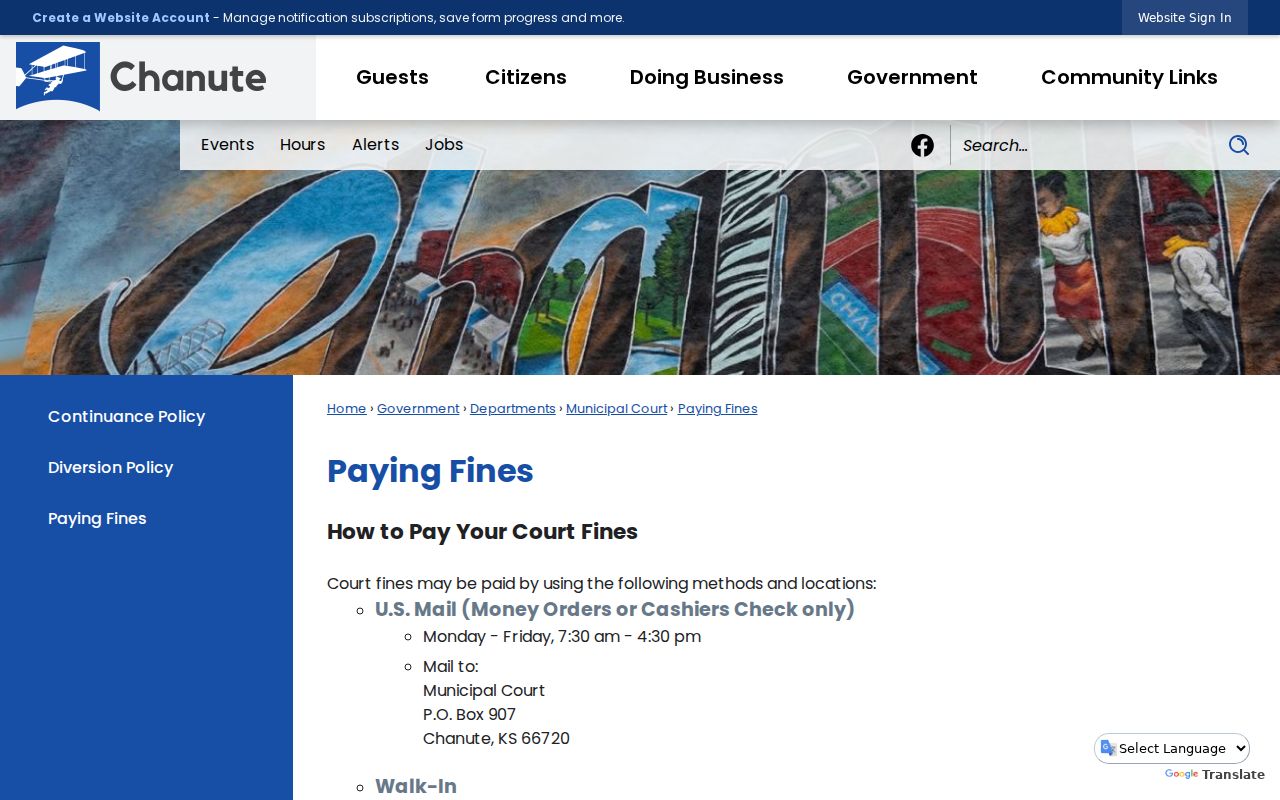
The city page walks you through paying; the court record itself stays with the municipal clerk.
Chanute Court Traffic Tickets
A Chanute ordinance ticket belongs to Chanute Municipal Court. A state citation naming Neosho District Court runs on the state docket, and it may route through the Kansas Central Payment Center. Check the court box on the citation before you pay anything. Appearing in the payment center system is no guarantee that every Chanute city ticket lands there. Gather the citation number, the exact court, the appearance date, and the issuing agency before you call. Then ask whether paying clears the appearance requirement. Ask too whether the case still needs a hearing. For the county-wide picture, see Neosho County traffic court records, which sorts out these distinctions in full.
The official Chanute Municipal Court source lays out the city-level court setting and its procedures.
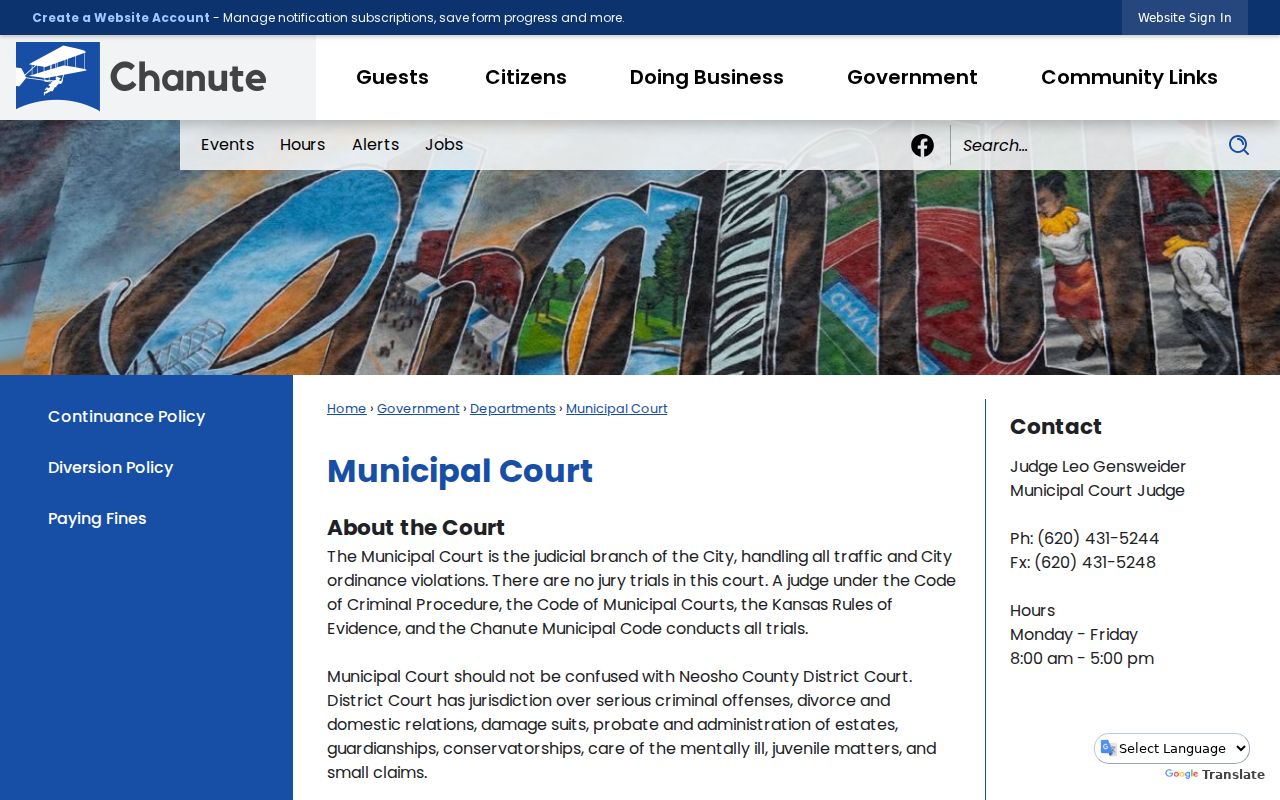
That page covers contacts and procedure, not a searchable docket database.
Chanute Court Clerk Counter
Where you go in Chanute depends on which clerk you need. The city FAQ puts the municipal clerk at 101 South Lincoln, a different office from the district filing desk even though both court systems sit close by. For a municipal copy, a payment question, or a hearing date, say Chanute Municipal Court. For a state case document, ask for the Neosho County District Court Clerk. The municipal clerk FAQ spells out the city-side details.
Keeping the two clerks separate keeps a city ticket request from landing at the state-court counter.
Where Chanute Court Cases End Up
Where a Chanute case ends up turns on its type. City ordinance matters stay municipal unless a later step moves them. State misdemeanors, felonies, civil suits, domestic matters, and the rest start in Neosho County District Court. The Chanute division holds many filings from 1955 forward. A hearing can still be set at either Neosho location.
Docket flow: Chanute Municipal Court › Neosho County courts › Kansas District Court, Neosho County District Court, 31st Judicial District
A municipal appeal lands in district court under K.S.A. 22-3609, and that step creates a brand-new district case rather than blending the two clerks' records together. For the county-level search layer, start with the Neosho County court docket overview.
Chanute Court Continuance Source
The assigned Chanute continuance source records the city policy discussed above.
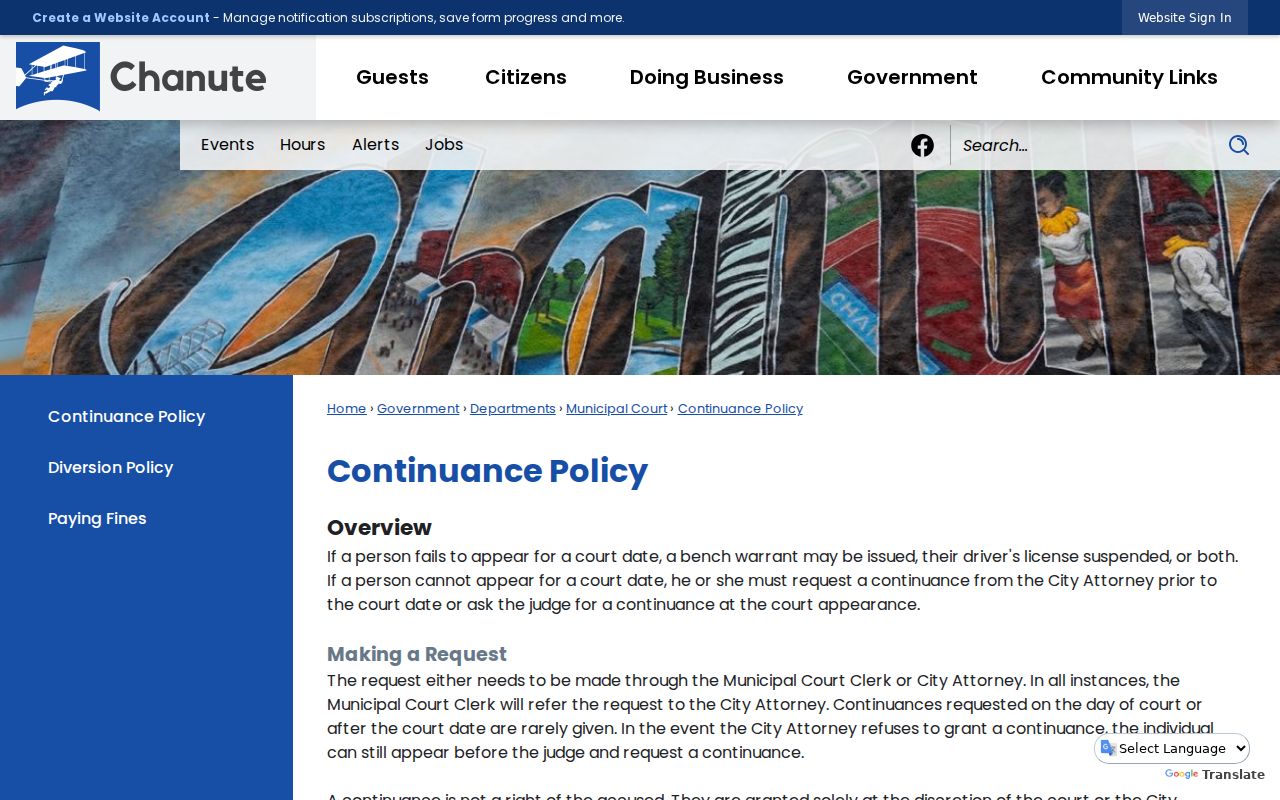
The lesson is narrow but real: get approval confirmed before you count on a changed hearing setting.
Public Access to Chanute Court Records
Access to Chanute court records depends on the record and who keeps it. City-court events and copies come from the Chanute municipal clerk. For a state case, use CaseSearch, a courthouse terminal, or the District Court Clerk. Kansas Rule 22 separates online public case information from terminal access and restricted material. Rule 24 shields certain personal identifiers. A document missing online may still sit on a terminal. A sealed or excluded record, though, stays closed even if you ask in person.
Key Rules:
Kansas Supreme Court Rule 22 sets the electronic and courthouse-terminal access levels.
Kansas Supreme Court Rule 24 requires protection of specified personal information.
K.S.A. 45-218 supplies the Kansas Open Records Act inspection framework.